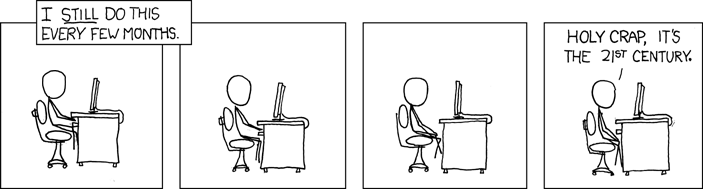
Even the most genuinely remarkable things can become commonplace, and only when you get a moment to reflect on them do you realize how incredible they really are.
Example: Every single time I'm in an airplane, sitting as it taxi's onto the runway, I think to myself: "In a few seconds, this machine is going to suddenly fire itself along the ground at 180mph or so, and then it's going to lift off of the ground and fly!"
And I know that I'm not the only one having this sort of experience:
So it's a little weird to me that I've never seen anyone else mention what, to me, seems like a very obvious revelation:
"Mount DOOM . . . really? That's what Tolkien called the big evil guy's home? Mount DOOM! That's the name he came up with. J.R.R. Tolkien, who worked out all this elaborate backstory of wars, magical objects, and songs about this thing some elves built one time, this man who essentially wrote his OWN fanfiction, he got up to the plate to pen his masterpiece and went "Eh, I'll just call it Mount Doom. That's a pretty sweet name. Cause, you know, it's a real bad place. And this way people will be able to tell."
Am I the only one who's a little thrown that Sauron, the big evil demon-overlord-whatever-the-hell-he-is-anyway, lives in a place that sounds like it was named by a Bond villian?
Quick test: Which one of these things seems out of place:
The Shire
Dimrill Dale
Ford of Bruinen
Isengard
Mount Doom
Yeah, that's what he actually went with. And they had to say it in the opening lines of the movie, and no one even snickered.
I used to work at . . . let's just say it's called "Big Summer Movie Release," but that was a long time ago . . . let's just say that in my interview the manager was very impressed that I'd heard of this new "DVD" thing.
You learn lessons from working retail, the most prominent of which is "don't ever work retail," with its corollaries "go to college so you don't have to work retail" and "be patient and understanding with people who work retail."
But some of the lessons are less obvious, like the one I learned when my store got a big shipment of "previously viewed" VHS tapes. I wondered for a long time why these tapes couldn't be sold at the stores they came from. After enough of them got returned, I realized that these were "Frankenstein" tapes. The company would take all the rental tapes that came back damaged, cut out the faulty section, and splice two or three tapes into one so they could sell it. And that's why those tapes, the ones with generic covers, were always really cheap.
And people like cheap, a lot. They like it so much, apparently, that they will open two sealed, unmarked cardboard boxes that are sitting out in the middle of a store, purely on the chance that the tapes inside will be discounted. Upon finding those tapes to be $3-5, they will then proceed to rummage through the boxes, buying stacks of ten tapes at a time.
I knew, on that day, that I was learning something important about the human race, but I wasn't sure what. Something about greed? Perhaps. The temptation of things that are easy and quick? Likely. But as I walked around in my local, gasping, coughing Circuit City, watching the vultures circle it, I realized that it has more to do with Tyler Durden and his resonant statement about "a generation working jobs we hate, so we can by sh*t we don't need."
*I decided to write this well before anyone died. :Sigh:
"History of the English Language" is a class most people would avoid at all costs. I am the sort of person who gets mentally sidetracked for a good ten minutes if he sees an advertisement for a sale on "our entire stock of socks." I mean the whole stock of them! The whole sock stock! I'm shocked at this stock of socks! I'm selling my stock in that shop because of this shocking sock stock sale!
So, yeah, for me it was a pretty fascinating class.
What I found most important in the subject matter was how the notion of "standard language," or what we think of as "correct" language (i.e. grammar, spelling) came to be. Spelling, for instance, was a child of the printing press. The people in that trade weren't going to fool with ten different spellings for the same word, so they picked a spelling and went with it. Having single spellings repeated through a large number of documents, no longer subject to the whims of individual longhand, gave them a kind of validation. And soon the "correct" spellings were being enforced in the classroom.
It's a strange thing, linguistically. Living languages are always changing. It's like a big ball of clay on which every speaker gets to place one finger. But they change through use.
So while our spoken language has evolved, gradually changing pronunciations over time, our written language has been largely frozen.
But it's fine. Though the idea of putting a lock on the language makes me somehow uneasy, I understand the practical need for a standardization.
Where it gets weird for me, though, is when we have competitions to see who can spell the best. It's like people don't understand that we made up the spellings. We might as well make up a correct way to eat pancakes, then put some kids on stage and see which one can eat pancakes closest to what we decided. That "skill" would be about as useful as knowing how to spell "gyromancy."*
Through intense research, which is to say that I made something up and think it's funny, I have determined that our modern speech requires a slight tweak.
The people who want Apple's iPhone, the people who use it, and the people who mock the people who use it are hitting a verbal wall when referring to the device.
People who love the iPhone are so enamored with it that they have trouble saying things like this:
"Yes, I have an iPhone."
See? "An" iPhone. How dingy and common that sounds to the Mac user! If you listen closely, you'll hear their voice quivver a little as they stumble past that clumsy article. They have hidden this device in their hearts, and need a way to ennoble that!
Similarly, people who make fun of the people who use iPhones have trouble describing the kind of distressingly amourous affection that's common among their iPhone-using friends.
"Oh what, you gonna play with your iPhone now?"
It just doesn't work quite right. "Your iPhone?" Mac-users aren't enamored with "this particular" device. They love it conceptually. They love the IDEA of it all.
And that's why I think my solution is so elegant. iPhone requires no article. It should not be referred to as a bunch of individual things, but as a substance.
"Yes, I have iPhone. I got iPhone when they released 3G iPhone. Hang on, I need to look something up on iPhone."
Not "an" iPhone, but just "iPhone."
And now the possessive isn't needed, either!
"Oh what, you gonna play with iPhone now?Oooh, look at that! My dropped calls have never looked so CRISP! The resolution is almost as high as the cost of the DATA PACKAGE!"
I think it's clear that this change is better for everyone. iPhone users get a way to speak of their device like a person, a friend. iPhone haters get a way to point out how rediculous it is that people think of this device as a person, a friend.
Please begin spreading this usage.*
*And when you see one in use, say "beep, beep, beep, iPhone, beep beep." It's always funny.
I'm very impressed if you're aware of EITHER "Elefunk" OR "World of Goo," and to expect you to know about both would be quite a stretch. So here's a quick primer:
Elefunk*
World of Goo
In Elefunk, you use bridge supports to strengthen the path of your elephant(s), so that they don't tumble into oblivion. If you took a middle school technology class, Elefunk will probably mark the first time in life you've been able to put that knowledge to work. I will be expecting my egg-drop simulator shortly, video game industry.
World of Goo also involves structures, except that you build them yourself from pulsing, sentient black globs. Somehow, this process is adorable. The principles of creating a sturdy structure still apply here, but all the pieces are being made as you go. It's construction without silly extras like rulers or right-angles.
At face value, these games have a lot in common:
-Both games are (to use one of those terrible "genre" things) puzzle games -Both are games of "pure physics." They are physics emulations with objectives built in. -As a result of this approach, the "solutions" in these games are free-form, there's no one "right" answer. If your "Elefunk"elephant makes it across the chasm, you win, even if the bridge looks like it's made of toothpicks. Similarly, so long as you get enough Goo into the pipe on each "World of Goo" level, you advance, no matter if your final structure is built on the fallen ruins of your first attempt.
Yet these games are very different. "Elefunk" is a game of math. It uses time-tested bridge supports that you connect in different ways. "World of Goo" is more fluid. It's messy and uncertain. Unless you've got a very steady hand and a lot of patience, you won't be making anything that's perfectly square. Instead you'll constantly be adjusting for tiny variations in your own work.
My high school art teacher would call these ideas "geometric" and "organic."
This dichotomy seems to exist everywhere in human thinking. I am a geek, so the first example that comes to mind is computer operating systems:
Windows has a very geometric feel with its constant Start Menu bar. The Mac OS is organic and flowing, changing the menu bar based on the current program. (Macs reinforce this idea with every stitch of their hardware, going out of their way to avoid right angles.)
But nowhere is this division more clear than in teaching. Those of us who got English degrees (or degrees in another humanity) have all heard the argument that we're being taught a theory, when we should be getting a skill (usually from people in business school, who now work in the next cubicle). This is the same logic at work, the organic (theory) and the geometric (skill).
It comes up again in martial arts, where there's often a debate about doing controlled (geometric) drills instead of more "real world" (organic) sparring drills. (Oddly, the "organic" approach is considered "practical" in this context.)
But the important part of the dichotomy is realizing that it's us making the distinction. The real world is one of organics, but understanding it often requires a geometric approach. Thinking is a process of systematizing, breaking the world down into pieces that can be understood. We learn the theory so that we can apply it to the practical. We practice controlled kicks and punches against a pad so we don't flail around against live target.
"Elefunk" and "World of Goo" are two halves of the same seed.
*Few things are more humbling than spending 5 solid minutes building a bridge only to have it collapse under its own weight. RIP, little elephant.**
Clearly, Yellow and Orange are the most hated of all the Starburst flavors.
Note: I'm refusing to refer to them as "Lemon and Orange," because they're pretty far removed from any genuine fruit heritage. I wish Orange didn't have it's little "my color is my name" thing, so I could properly denigrate its candy stand-in.
How did "Orange" even manage that deal? The color and fruit have the same name in almost every language. If there's a Discworldian god of oranges, I'll bet he's got a lot of political savvy.
I may be getting off topic.
The candy jar dynamics of Starburst seem to be pretty consistent in this country. Red-gone. Pink-gone*. Orange and Yellow, still around!
In France, though, it's the red and orange that go first, and they see our love for pink Starburst as a mark of unrefined taste (this is probably something I made up).
Why do they make orange and yellow at all? Since they're so frequently passed over, shouldn't the whole package be made up of red and pink? Is there some powerful citrus lobby I'm not aware of?
Perhaps, like the peanuts of the "mixed nut" industry, orange and yellow are simply cheaper to produce, and thus get used as filler. Or maybe those flavors are designed to be palate cleanser, enhancing the red and pink flavors as you make you way through a package.
Or maybe it's a weird sociological thing, where no one would buy a product with only two flavors, because that wouldn't be enough variety. People want choices, even if a good half of those choices are crappy.
*I love how pink is everyone's favorite, but no one can tell you what the hell flavor that's supposed to be. According to the people at Starburst, that's supposed to be strawberry . . . I find that somehow terrifying.
1. If a zombie-virus ever breaks out during Halloween, we're doomed. Our culture's zombie-preparedness is critically low all year long, but at least people are capable of recognizing a shambling, animated corpse when it walks down the street. But during Halloween, there's no telling how long the infected would move through our streets, slowed only by dozens of "best costume" awards.
2. People expect me to dress up, and I don't want to.
And you can't just NOT wear a costume, not if you want to be out in the world with other human beings*. Go out in regular clothes and you'll be forced into this conversation over and over again:
"So . . . what are you dressed up as?" (said ever so condescendingly)
"*sigh* I'm-not-dressed-up."
"Psshhht . . . LAME!"
Yes! People will use the word "lame" in conversation! To make fun of another person's choices! This is a thing that happens!
It's as though the costumes drag people toward childhood without letting them quite reach it, and they wind up in high school again. (Ironically, a period when they probably didn't dress up for Halloween.) Suspended for the night in those teenage years, normal adults are compelled to interrogate their social world again.
Fortunately I've found the solution to the whole problem, and I'm glad to share it with the world: Just wear a hat. Get an unusual hat, a fedora will do, and wear it with some normal clothes. And just like that, no one will bother you. Even though they can't immediately tell what you're dressed as, the mere presence of this single unusual item will throw you off their "dork" radar.
The only conversation you'll have to deal with is:
"As you dressed as *person's guess here*?"
"Yes, yes I am."
*At least you'd better HOPE those are human beings, and not dangerous zombies!
I guess, in some respects, I've come back around on restaurant punch cards.
I think Subway started it years ago with their stamp cards, and now you can't run a coffee shop, ice cream store, or smoothie place without them. I'm sure Red Lobster would be all over it if they could just figure out how to make a hole punch that looked like a crustacean. I would love it if the trend continued it's way up the retail ladder, and somewhere a guy was getting a free car because he had a little card in his wallet with enough stamps: "Are you sure you want to use this now? Because if you started a new card and got it half full you could get a van!"
Or maybe there's a company that sells exotic animals: "Hey, that's number 10 for you! I'll go get your monkey!" I can just see him there, holding a little yellow card with monkey-face stamps.*
Only it would never happen. There's a cap to where the punch-model will work. Why? Because the only things given away for free are ones that are nearly valueless.
It's a pretty distressing thought. Not only do I regularly buy (or in the case of smoothies, put a down payment on) things that have no real value, but knowing that they have no value I will continue to buy them. I'm aware that fruit, yogurt, orange juice, and whatever roofing compound they sell as "enhancers" and "boosts" doesn't cost that much, and apparently I'm ok with it.
Their promotional endeavors have brought the nature of their business model into stark relief. They sell, for %75 of a full meal's cost, the service of hitting a blender's "On" button. But that doesn't change the fact that there's a solid hour between when I'm done running at the track and when Karate starts, and I need something in my stomach that won't turn to cement while I'm kicking a pad.
So do I want a Strawberry Extreme? Or a Banana-berry treat?
*Gary Larson, my stuff is copyright Sam Cook. So I had better not see this pop up in anybody's one-a-day calendar.
Art is, at its root, a collaborative effort between artist and audience. Creators extend a work into the world, and other people reach out to grab onto some part of it. Some of the audience will grasp it with both hands. Others will catch a single rung and hang on for the ride. A few will look at the work quizzically and conclude that it's a large plate of spaghetti, and thus it isn't fit to be used as a handhold. Every viewer re-authors the work for his own mind, finding a place for it (if there's room) in his own point of view.
And this is why appreciating creative works is a skill unto itself, with its own hurdles and pitfalls that have to be dealt with.
1. There is a difference between something that's "bad" and something that you, personally, don't like. Realizing that is difficult enough, learning to tell the difference is even harder. And it's made more difficult by . . .
2. You don't have to defend your likes/dislikes. People will want you to defend your preferences because many of them don't understand #1. They assume that, if you don't like something that they enjoy, then you think it is "bad" and that they are therefor "stupid" for liking it. (Mind you, these people are often stupid, just not for that reason.) All this being said: No, I don't like Homestar Runner. I don't think it's funny. And I'm tired of getting crap about it.
3. If you don't like something, walk away from it. You'd think this would be easy, but it really isn't. Sometimes you've heard so much about a book being good that you keep reading it long after you've lost interest. Or you'll watch the rest of a movie that you find boring simply because it seems like the kind of thing you usually enjoy.
Or, as was the case with Metal Gear Solid 2, I'd spent so much time following the game's development that my mind simply wouldn't accept that it wasn't awesome. This delusion persisted even after I was tasked with defeating a very large man on rollerblades who threw sticks of dynamite at me. (That is NOT a joke, it is literally something from the game.)*
Grinding your way through a work that you don't like is terrible for you. It makes you disenchanted with the medium, and is generally a waste of your lesiure time.
*This also explains why I walked out of every Star Wars Episode 1-3 movie thinking that it was "alright," and didn't realize it was bad until I woke up the next morning in a cloudy, sickened haze. You know, they should have really put a fat guy on rollerblades IN Star Wars Episode 1. I mean if you're going to screw it up that bad, you might as well go crazy!
Delicious. Healthy as far as desserts go. Fun to eat.
So how come you haven't had one in like ten years?
Why is this concoction limited to fair grounds and Six Flags when it's a nutritious alternative for your snacking needs? What has brought about such a culinary typecast?
Is it the stick? The candied apple is easy to carry, so therefore you can only eat it at places where you do a lot of walking around? Has the dessert been hamstrung by its own portability?
But that doesn't make sense, because corn dogs are a staple of school cafeterias, but I don't remember even one time that I walked into the lunch room and saw a row of candied apples.
I think the root of it is this strange thing people have about associations. Order a cup of hot chocolate in July and see how long it takes someone to ask, "Eww, how can you drink that? It's so hot outside!"*
What difference does that make? Are you outside? It's not like the local Starbucks is an open-air street vendor. You're making a decision based on what the temperature is somewhere else. If we're going that far, why not eat based on what the weather is like in other countries?
"Well it's winter in Japan right now, let's make some soup."
*They say this, of course, while holding a boiling hot cup of coffee.