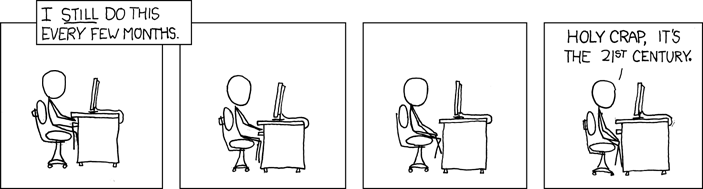
All my life people have been telling me to be myself. Teachers, camp councilors, Mr. T, Audioslave, Latawnya*, the list goes on and on.
The logic behind this message is that, by asserting myself as an individual, I won't be tempted into "drinking and smoking drugs" and other such dangers. I guess that's all well and good, but now that I'm well past the age when those things were a concern, I find myself with some serious issues toward the whole "be yourself" philosophy.
Namely, what if "who you really are" is a super-crappy person?
The underlying thesis of those PSA's seems to be that everyone is good on the inside, and they only do bad things because of outside influences.
So how does that figure in with all the terrible things that people have done? Were all those invasionary wars started because it's what all the cool kids were doing? Were history's ruthless dictators commiting atrocities because they were tricked by some older kids?
No . . . here I think GI Joe would have to concede the point.
"Kids, if being who you are is hurting other people, yourself, or generally bringing negative things into the world, how about you just go be someone else instead? Eh?Sometimes it's ok to care what other people think, if they're good, moral people."
The More You Know
*Cue Star Logo*
*Can I tell you how tempted I am to click the "I'd like to read this book on Kindle" link?
-Listening to Stevie Wonder's music can be frustrating, because for every "Signed, Sealed, Delivered" there's an "Overjoyed." (Which is to say, for every really great song he's also got the worst kind of sappy elevator track you can imagine.) And no one gets in your car when you're listening to the good ones either. No, they open the door right as Stevie's talking about "climbing the tower of your heart" or something like that.
-Has anyone noticed that lately all the sandwich places want to sell pizza, and all the pizza places want to sell sandwiches? Are these secretly warring factions, each of them overflowing with anger that someone else is charging for "bread with stuff on it."
-I love it when game designers, desperate to change up the perfectly competent zombie-shooting they've been working on, throw a logic puzzle into the mix. Does that even make sense? I'm sorry, but if I were an evil overlord, I'm not sure I'd trust my secret antidote to one of those slider puzzles that children do.*
Instead, I think I'd probably just walk down to the store, buy a metal padlock with a key, and call it good. Seems like that would keep the hero occupied a lot longer than a jumbled picture of my family crest.
-In comedy duos, such as Dean Martin and Jerry Lewis, you usually have one guy who acts normal and reasonable while the other guy is all wacky. These two roles are traditionally called the "straight man" and the "comic relief."
It recently came to my attention that I'm the only person I know who's familiar with those terms, which is particularly frustrating while playing a party game that wants me to make people guess one of them.
*Of course, when I bring down a zombie-dog and find that it was carrying (CARRYING, mind you, I guess on some sort of fanny pack since dogs don't exactly have thumbs.) fourteen rounds of shotgun ammo . . . that's not a problem.
"DEAR SAM: I am 8 years old "Sometimes my parents say that there's no such thing as zombies. "But my little friends say that they're real. "Please tell me the truth; is there a threat of a zombie apocalypse?
"VIRGINIA BROOKS "720 WEST VALVE STREET
VIRGINIA, your parents are wrong. They have been infected by the skepticism of a skeptical age. They do not believe except they see. They think that nothing can be which is not comprehensible by their little minds . . .either that, or their little minds are now swarming with a zombie virus, one which has perhaps evolved to invoke skepticism in its hosts.
Yes, VIRGINIA, there is a threat of a zombie apocalypse. It exists as certainly as machetes and chainsaws and preparedness exist, and you know that those abound and give to your life it's highest peace of mind. Alas! how slovenly would be the world if there were no threat of a zombie apocalypse! There would be no motivation to train ourselves physically and mentally, no constant reminder to appreciate each moment of our lives.
Not believe in the zombie virus! You might as well not believe in ninjas! You might get your papa to hire men to watch the streets for roaming undead, but if they did not see any roaming undead, what would that prove? And now that I think about it, that's a really good idea. If your papa has the resources, get him on this zombie squad thing, now.
You may tear apart the baby's rattle and see what makes the noise inside, but there is a veil covering the unseen world which not the strongest man, nor even the united strength of all the strongest men, could tear apart. And if we don't learn to see through that veil, Virginia, before the zombie apocalypse comes, we actually will be facing THE UNITED STRENGTH OF THE WORLDS STRONGEST MEN, each of them a brain-eating monster! And believe me, they will tear apart more than baby rattles.
No zombies! Oh they live, and they live forever. A thousand years from now, Virginia, nay ten times ten thousand years from now, the will continue to stumble and groan across the ruins of our cities, unless you and I march forward to stop them. Good luck, and God help us all. *This is a line from "Left for Dead" by Citizen Cope. "Left4Dead" is the name of a popular computer game about surviving in a zombie apocalypse. The reference is so obscure, I figured it was better just to explain it.
War drums echo through the heavens as a rollup slowly crawls into infinity.
November 5, 2055
It is a dark time for humanity. No more do the cities light up as night falls across them. No more do they sparkle with the electric glow of life, still buzzing about in defiance of sunset. Now there is only the terrible tide of the zombie horde, gradually wearing away at the last testaments of mankind's existence.
But there is one hope, one last chance to make the world over. On a hilltop in Japan, the ancient order of the Ninja has emerged in this terrible hour. Here they have made a stand, beating back the undead monsters with skill, cunning, and a small army of terrifying robots they built. They are the Folded Steel clan, defenders of the flame.
Atop the clan's fortress of New Guardia, a brilliant young computer scientist has spent months in communion with the last remaining artificially intelligent supercomputer, searching for a cure to the hideous plague. And now, at last, a solution has been found-though it comes with a terrible price.
Through it's investigations into the physical world, the AI computer has invented a time travel device. With it, a single warrior could escape into the past, find the cause of the outbreak, and destroy it. The future as it is will be unmade. The noble men and women who hold back the tide of evil will have never been. The lone fighter will be abandoned forever in history.
Armed with only his spirit, his sword, a sniper rifle, and an array of cyborg enhancements, the ninja steps into the chronopult and vanishes . . .
Emporer Augustus was touring his Empire and noticed a man in the crowd who bore a striking resemblance to himself. Intrigued he asked: "Was your mother at one time in service at the Palace?" "No your Highness," he replied, "but my father was."
Emporer Augustus, Two-thousand years ago
Painter: "Y'are a dog." Apemantus: "Thy mother's of my generation. What's she, if I be a dog?"
William Shakespeare, Act 1 Scene 1 of Timon of Athens, late 1500's/early 1600's
"I like yo' momma — sister, too"
Blues artist Kokomo Arnold, "Twelves (Dirty Dozens)" Early 1930's
"Your mama don't dance and your daddy don't rock and roll"
Kenny Loggins and Jim Messina, from the song of the same title, 1972
-Ok, you're qualified for this job, how about a starting salary, $5000? "
-Yo mama!
-Um, $7500 a year...?
-Yo GRAND-mama!
Richard Pryor, "Saturday Night Live" sketch, 1975
"You are so stupid. It would take your mother 1, no. 2 hours to watch 60 MINUTES"*
Ron Shelton, "White Men Can't Jump," 1992
"Your mom's retarded."
"No your mom's retarded."
Some middle school kids at the Smoothie King while I was in line, 2008
*The TV show "How I Met Your Mother" made this considerably harder to research on the internet . . . "How I Met Your Mother" is hurting America.
Even the most genuinely remarkable things can become commonplace, and only when you get a moment to reflect on them do you realize how incredible they really are.
Example: Every single time I'm in an airplane, sitting as it taxi's onto the runway, I think to myself: "In a few seconds, this machine is going to suddenly fire itself along the ground at 180mph or so, and then it's going to lift off of the ground and fly!"
And I know that I'm not the only one having this sort of experience:
So it's a little weird to me that I've never seen anyone else mention what, to me, seems like a very obvious revelation:
"Mount DOOM . . . really? That's what Tolkien called the big evil guy's home? Mount DOOM! That's the name he came up with. J.R.R. Tolkien, who worked out all this elaborate backstory of wars, magical objects, and songs about this thing some elves built one time, this man who essentially wrote his OWN fanfiction, he got up to the plate to pen his masterpiece and went "Eh, I'll just call it Mount Doom. That's a pretty sweet name. Cause, you know, it's a real bad place. And this way people will be able to tell."
Am I the only one who's a little thrown that Sauron, the big evil demon-overlord-whatever-the-hell-he-is-anyway, lives in a place that sounds like it was named by a Bond villian?
Quick test: Which one of these things seems out of place:
The Shire
Dimrill Dale
Ford of Bruinen
Isengard
Mount Doom
Yeah, that's what he actually went with. And they had to say it in the opening lines of the movie, and no one even snickered.
I used to work at . . . let's just say it's called "Big Summer Movie Release," but that was a long time ago . . . let's just say that in my interview the manager was very impressed that I'd heard of this new "DVD" thing.
You learn lessons from working retail, the most prominent of which is "don't ever work retail," with its corollaries "go to college so you don't have to work retail" and "be patient and understanding with people who work retail."
But some of the lessons are less obvious, like the one I learned when my store got a big shipment of "previously viewed" VHS tapes. I wondered for a long time why these tapes couldn't be sold at the stores they came from. After enough of them got returned, I realized that these were "Frankenstein" tapes. The company would take all the rental tapes that came back damaged, cut out the faulty section, and splice two or three tapes into one so they could sell it. And that's why those tapes, the ones with generic covers, were always really cheap.
And people like cheap, a lot. They like it so much, apparently, that they will open two sealed, unmarked cardboard boxes that are sitting out in the middle of a store, purely on the chance that the tapes inside will be discounted. Upon finding those tapes to be $3-5, they will then proceed to rummage through the boxes, buying stacks of ten tapes at a time.
I knew, on that day, that I was learning something important about the human race, but I wasn't sure what. Something about greed? Perhaps. The temptation of things that are easy and quick? Likely. But as I walked around in my local, gasping, coughing Circuit City, watching the vultures circle it, I realized that it has more to do with Tyler Durden and his resonant statement about "a generation working jobs we hate, so we can by sh*t we don't need."
*I decided to write this well before anyone died. :Sigh:
"History of the English Language" is a class most people would avoid at all costs. I am the sort of person who gets mentally sidetracked for a good ten minutes if he sees an advertisement for a sale on "our entire stock of socks." I mean the whole stock of them! The whole sock stock! I'm shocked at this stock of socks! I'm selling my stock in that shop because of this shocking sock stock sale!
So, yeah, for me it was a pretty fascinating class.
What I found most important in the subject matter was how the notion of "standard language," or what we think of as "correct" language (i.e. grammar, spelling) came to be. Spelling, for instance, was a child of the printing press. The people in that trade weren't going to fool with ten different spellings for the same word, so they picked a spelling and went with it. Having single spellings repeated through a large number of documents, no longer subject to the whims of individual longhand, gave them a kind of validation. And soon the "correct" spellings were being enforced in the classroom.
It's a strange thing, linguistically. Living languages are always changing. It's like a big ball of clay on which every speaker gets to place one finger. But they change through use.
So while our spoken language has evolved, gradually changing pronunciations over time, our written language has been largely frozen.
But it's fine. Though the idea of putting a lock on the language makes me somehow uneasy, I understand the practical need for a standardization.
Where it gets weird for me, though, is when we have competitions to see who can spell the best. It's like people don't understand that we made up the spellings. We might as well make up a correct way to eat pancakes, then put some kids on stage and see which one can eat pancakes closest to what we decided. That "skill" would be about as useful as knowing how to spell "gyromancy."*
Through intense research, which is to say that I made something up and think it's funny, I have determined that our modern speech requires a slight tweak.
The people who want Apple's iPhone, the people who use it, and the people who mock the people who use it are hitting a verbal wall when referring to the device.
People who love the iPhone are so enamored with it that they have trouble saying things like this:
"Yes, I have an iPhone."
See? "An" iPhone. How dingy and common that sounds to the Mac user! If you listen closely, you'll hear their voice quivver a little as they stumble past that clumsy article. They have hidden this device in their hearts, and need a way to ennoble that!
Similarly, people who make fun of the people who use iPhones have trouble describing the kind of distressingly amourous affection that's common among their iPhone-using friends.
"Oh what, you gonna play with your iPhone now?"
It just doesn't work quite right. "Your iPhone?" Mac-users aren't enamored with "this particular" device. They love it conceptually. They love the IDEA of it all.
And that's why I think my solution is so elegant. iPhone requires no article. It should not be referred to as a bunch of individual things, but as a substance.
"Yes, I have iPhone. I got iPhone when they released 3G iPhone. Hang on, I need to look something up on iPhone."
Not "an" iPhone, but just "iPhone."
And now the possessive isn't needed, either!
"Oh what, you gonna play with iPhone now?Oooh, look at that! My dropped calls have never looked so CRISP! The resolution is almost as high as the cost of the DATA PACKAGE!"
I think it's clear that this change is better for everyone. iPhone users get a way to speak of their device like a person, a friend. iPhone haters get a way to point out how rediculous it is that people think of this device as a person, a friend.
Please begin spreading this usage.*
*And when you see one in use, say "beep, beep, beep, iPhone, beep beep." It's always funny.
I'm very impressed if you're aware of EITHER "Elefunk" OR "World of Goo," and to expect you to know about both would be quite a stretch. So here's a quick primer:
Elefunk*
World of Goo
In Elefunk, you use bridge supports to strengthen the path of your elephant(s), so that they don't tumble into oblivion. If you took a middle school technology class, Elefunk will probably mark the first time in life you've been able to put that knowledge to work. I will be expecting my egg-drop simulator shortly, video game industry.
World of Goo also involves structures, except that you build them yourself from pulsing, sentient black globs. Somehow, this process is adorable. The principles of creating a sturdy structure still apply here, but all the pieces are being made as you go. It's construction without silly extras like rulers or right-angles.
At face value, these games have a lot in common:
-Both games are (to use one of those terrible "genre" things) puzzle games -Both are games of "pure physics." They are physics emulations with objectives built in. -As a result of this approach, the "solutions" in these games are free-form, there's no one "right" answer. If your "Elefunk"elephant makes it across the chasm, you win, even if the bridge looks like it's made of toothpicks. Similarly, so long as you get enough Goo into the pipe on each "World of Goo" level, you advance, no matter if your final structure is built on the fallen ruins of your first attempt.
Yet these games are very different. "Elefunk" is a game of math. It uses time-tested bridge supports that you connect in different ways. "World of Goo" is more fluid. It's messy and uncertain. Unless you've got a very steady hand and a lot of patience, you won't be making anything that's perfectly square. Instead you'll constantly be adjusting for tiny variations in your own work.
My high school art teacher would call these ideas "geometric" and "organic."
This dichotomy seems to exist everywhere in human thinking. I am a geek, so the first example that comes to mind is computer operating systems:
Windows has a very geometric feel with its constant Start Menu bar. The Mac OS is organic and flowing, changing the menu bar based on the current program. (Macs reinforce this idea with every stitch of their hardware, going out of their way to avoid right angles.)
But nowhere is this division more clear than in teaching. Those of us who got English degrees (or degrees in another humanity) have all heard the argument that we're being taught a theory, when we should be getting a skill (usually from people in business school, who now work in the next cubicle). This is the same logic at work, the organic (theory) and the geometric (skill).
It comes up again in martial arts, where there's often a debate about doing controlled (geometric) drills instead of more "real world" (organic) sparring drills. (Oddly, the "organic" approach is considered "practical" in this context.)
But the important part of the dichotomy is realizing that it's us making the distinction. The real world is one of organics, but understanding it often requires a geometric approach. Thinking is a process of systematizing, breaking the world down into pieces that can be understood. We learn the theory so that we can apply it to the practical. We practice controlled kicks and punches against a pad so we don't flail around against live target.
"Elefunk" and "World of Goo" are two halves of the same seed.
*Few things are more humbling than spending 5 solid minutes building a bridge only to have it collapse under its own weight. RIP, little elephant.**